
For tint, PPF and coating shops · Runs while you're sweating in the back seat
Stop quoting by text.
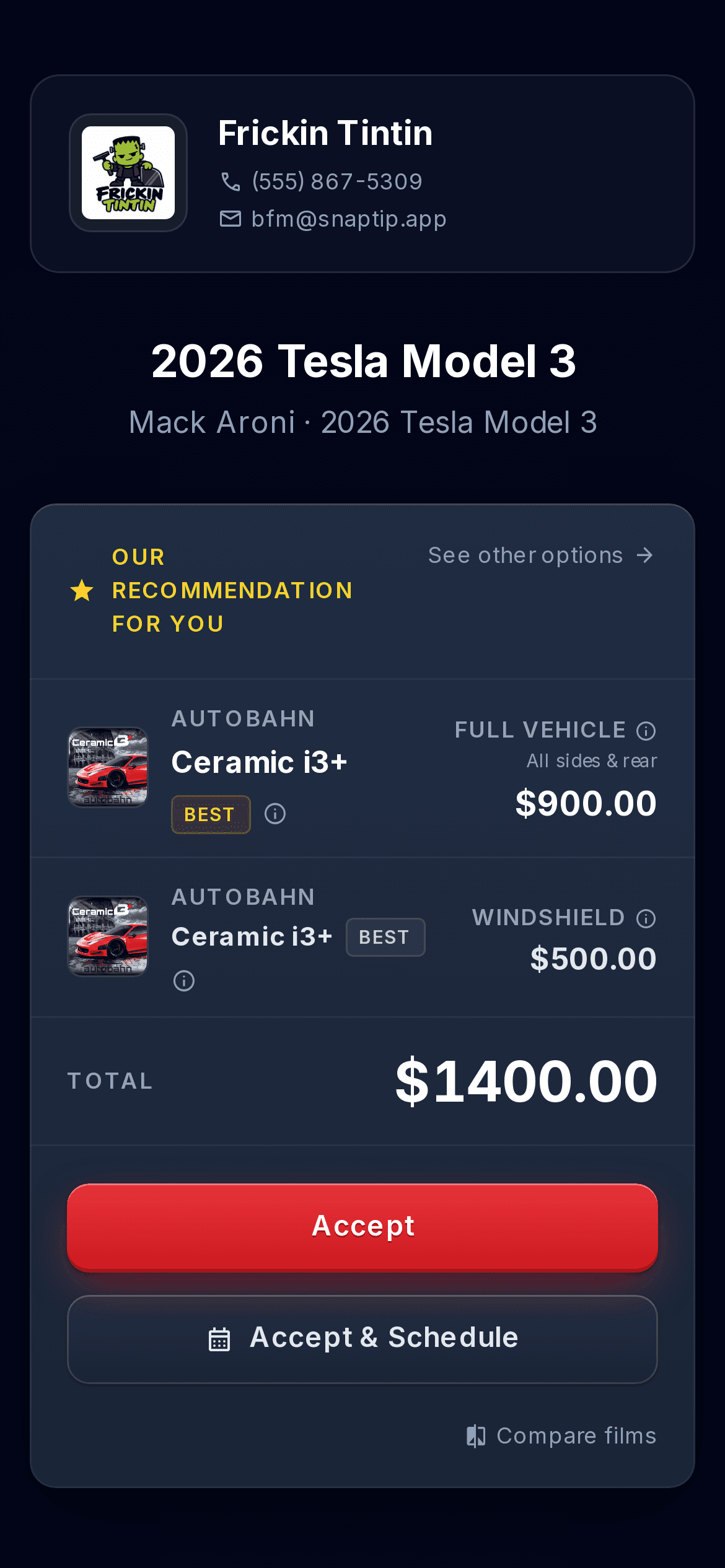
SnapTip turns the most important thing you do all week into one link: film options side by side, priced for their car, signed and scheduled from their phone.
30 days free. No card. Cancel from your settings.
From a tinter who ran the systems for eight locations. 30 days free, no card. $79/mo per location, locked for life for the first 25. A location is an address, not a bay.
$600 whole car, $850 ceramic, $1,100 for the good ceramic
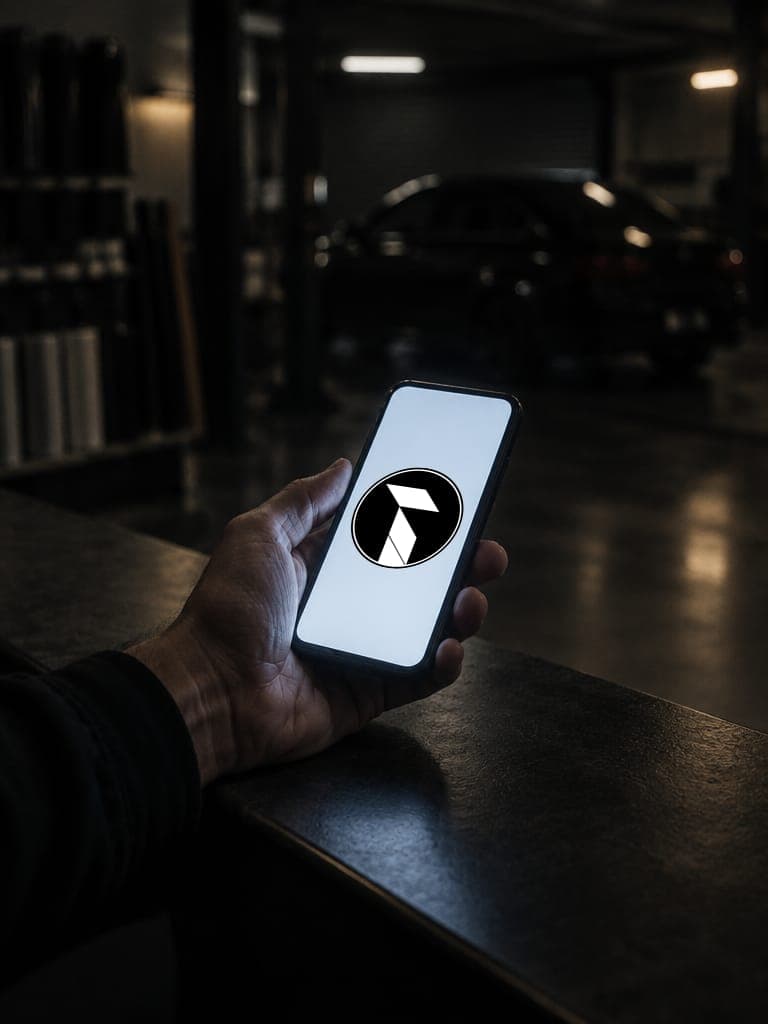
Where the shop lives today
Your shop is in your head.
A phone, a notebook and a text thread are running a business that bills six figures a year.
Tue 4:12 PM · Text message
$350 for the fronts, $600 for the whole car. Let me know.
Wed 9:40 AM · The notebook
Every car is a different price and it's all in my head.
Fri 6:05 PM · The text thread
Twenty quotes out. No idea which ones are still alive.
The price is in your head. The quote is in a text. The schedule is a whiteboard only you can read. When you're in the back seat with the liner off, the shop stops. None of that is your fault. It's the tools.
01 · The quote
The problem“$350 for the fronts, $600 for the whole car” typed into a text is why price becomes the only thing they compare.
Good. Better. Best.
- Three film options side by side, with the specs behind each one, priced from your own catalog for that exact car.
- The customer picks, signs and books a slot from their phone. No callback.
- A web lead, an ad, a QR code on the counter: the form builds the proposal itself, so they have a real quote in minutes, not two days.
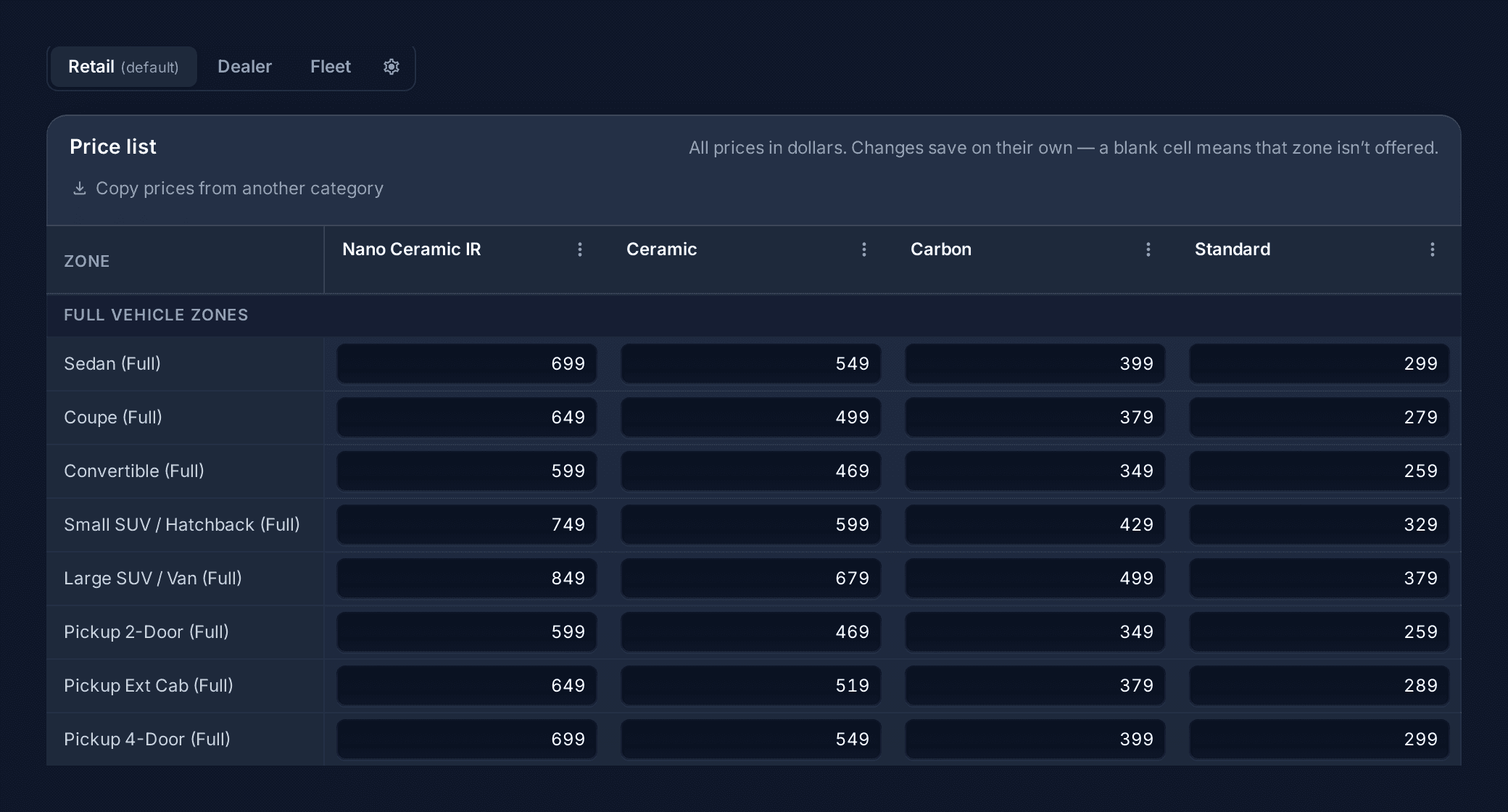
The problemA Tahoe is not a Civic, and the rear glass on a Model 3 is different than an Altima.
Every car. Already priced.
- Prices live per film, per zone, per customer tier, with modifiers by make, model and year range.
- Pick the car from a window-tint-specific vehicle database we built ourselves, with make, model, body style, and generations going back to 1947. The price comes out right because the database knows the car, not because an AI guessed.
- Anyone at the counter quotes like you. Three cars in the family, one link; each car books and invoices on its own.
30 days free. No card. Cancel from your settings.
02 · The rest of the loop
From the quote to paid.
Getting paid
The problemChasing money is a second job: a text, a payment app, a card number read over the phone, cash in the drawer.
Owed is one number.
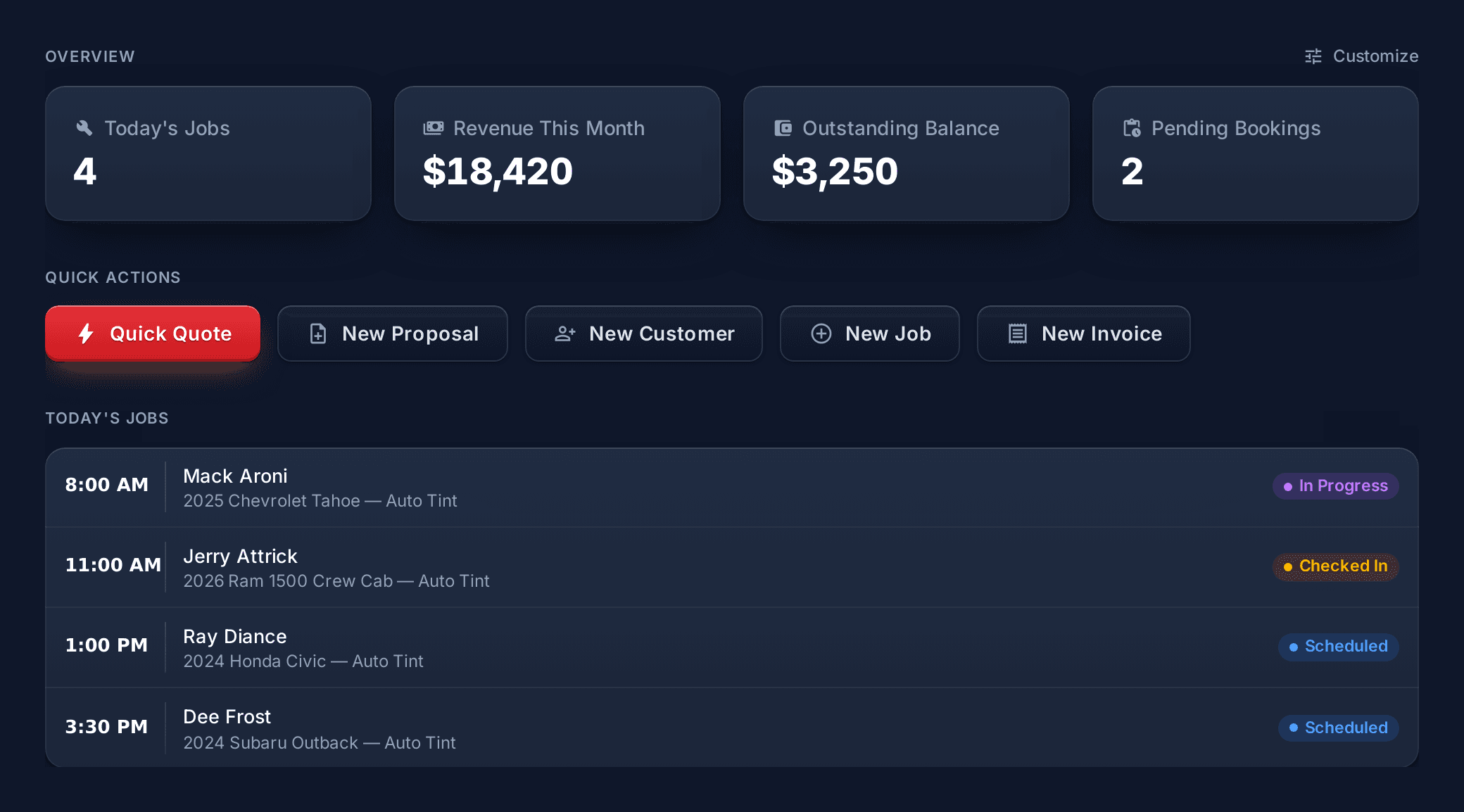
- Invoice in one click from the accepted proposal. They pay from the link, on the reader at the counter, or you log the cash and the check.
- A deposit holds the slot. No deposit, no booking. The deposit rides onto the final invoice.
- Tips go to the installer who did the work, not into your sales number.
The calendar
The problemDouble bookings, techs who learn their day when they walk in, and every full tint booked for “about three hours.”
Every tech knows their day.
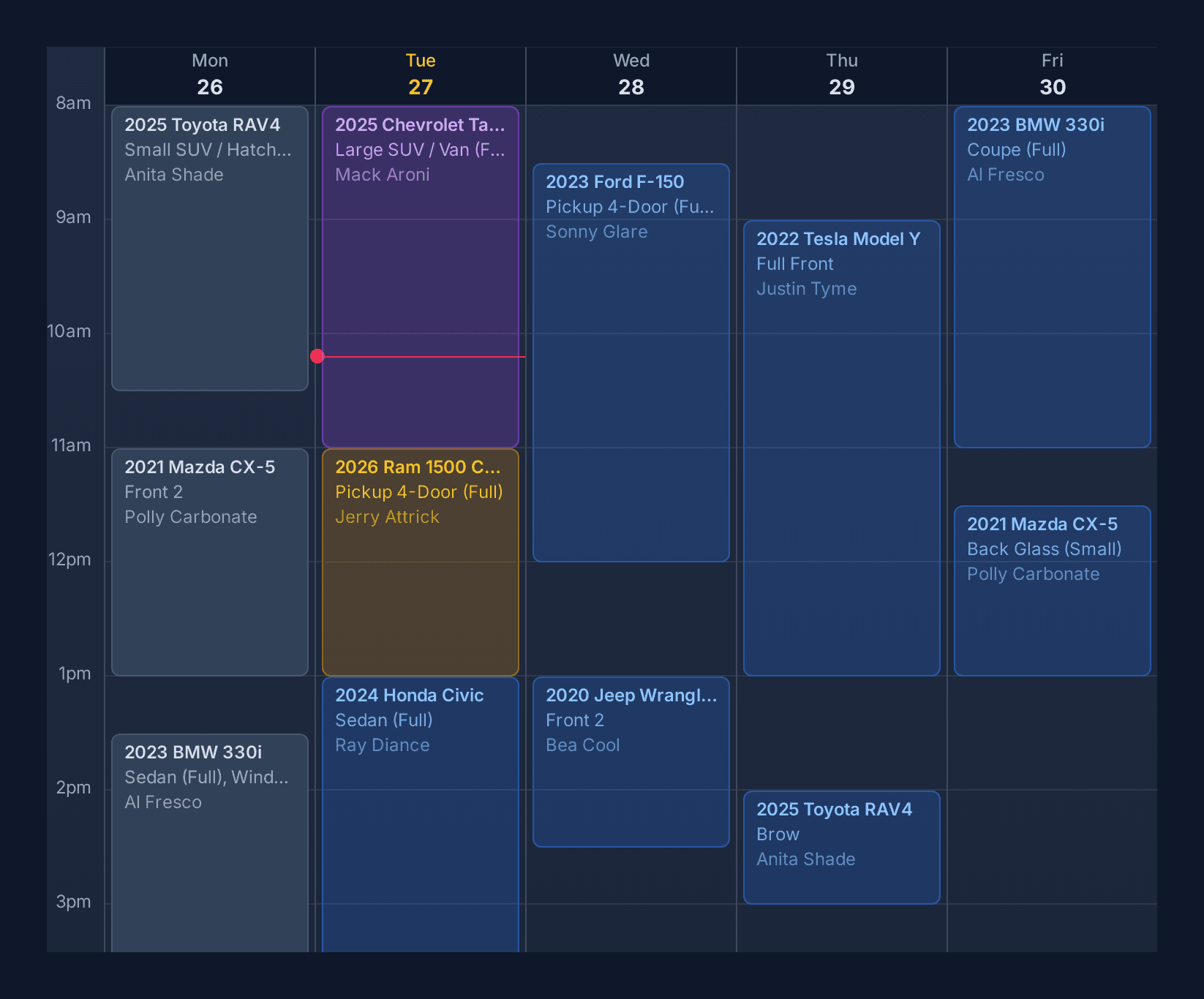
- Week, day and per-tech views. Drag a job and it shows up on your own Google or iPhone calendar, so your phone still works.
- A public booking page: they pick the service and the time, pay the deposit, and the job lands on the calendar while you're sweating in the back seat.
- Every installer sees their day before they walk in.
Following up
The problemTwenty quotes out, no idea which are still alive, and the cheapest sale you'll ever make is the one you already quoted.
Quiet quotes call you.
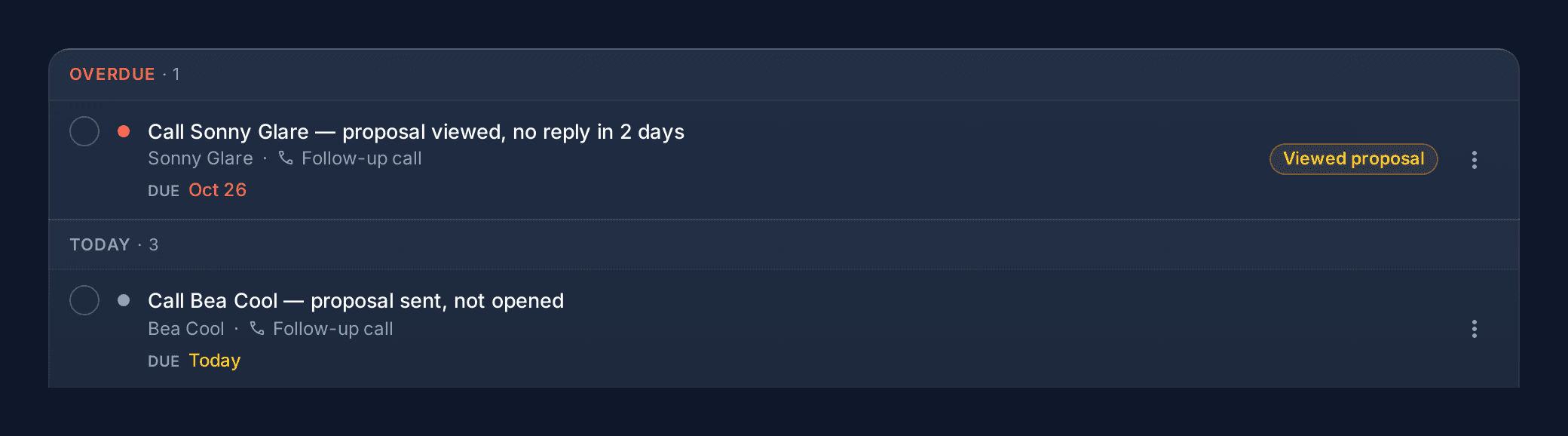
- A proposal that goes quiet becomes a call task on its own. Hot ones flagged.
- Log the call in two taps. The next touch schedules itself.
- Reminders, review requests, overdue nudges: rules you switch on once.
The shop floor
The problemNothing written down between the sale and the bay is how the wrong windows get done and the wrong scratch gets blamed.
Every scratch is on record.
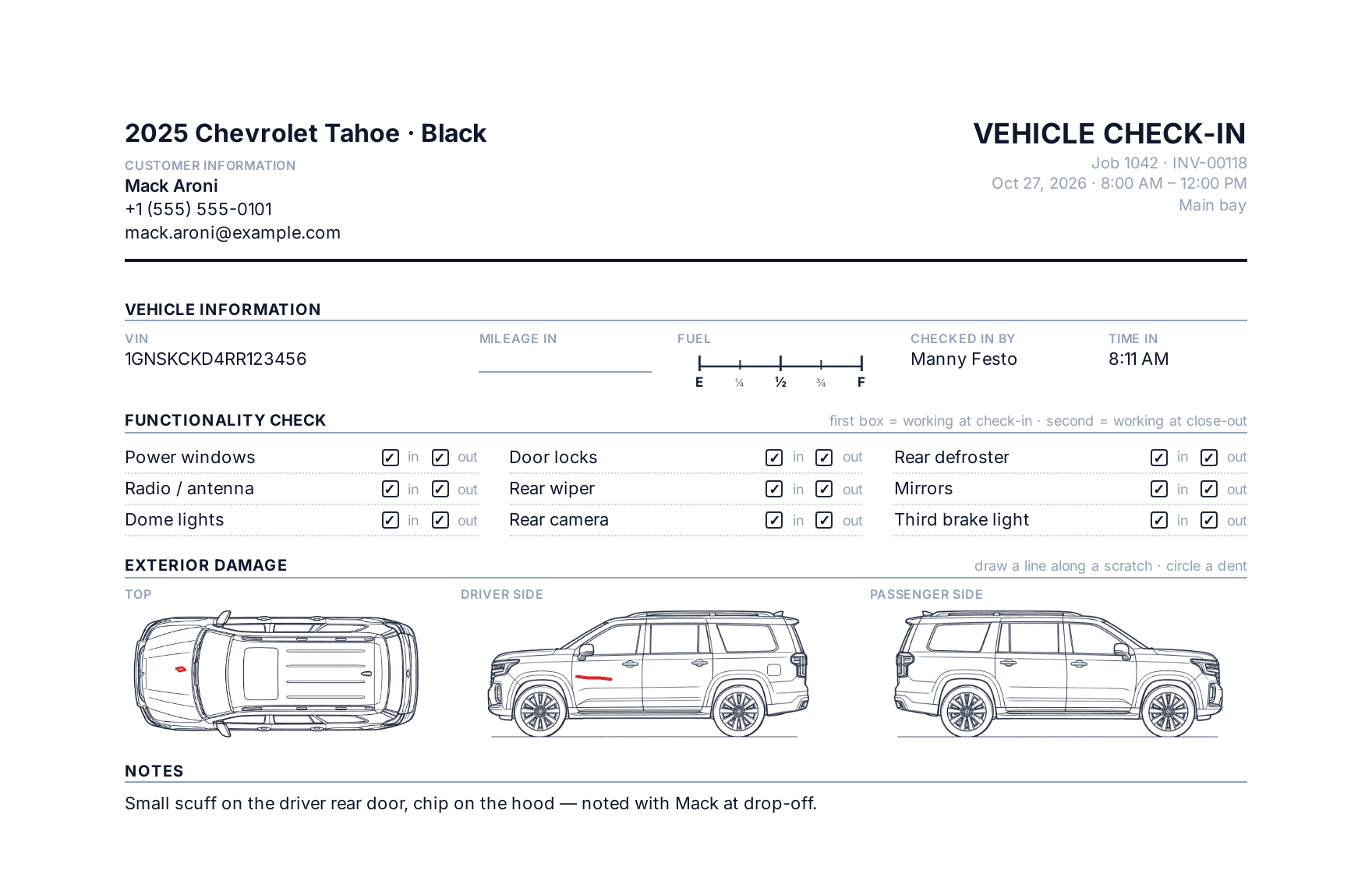
- Check-in with photos and initials, a printed work order from what they signed.
- Start, complete, ready, picked up. The customer hears at each step.
- Film pulled at close-out, by the roll. Comebacks counted, per tech, per film.
03 · Film, crew, Snappy
The rest of the shop.
Film
The problemFilm is your biggest cost after labor, and the half-rolls nobody logged don't show up anywhere.
Know what's on the shelf.
- Rolls by SKU, VLT and width under each film. Purchase orders, receiving at real cost, low-stock alerts.

Your crew
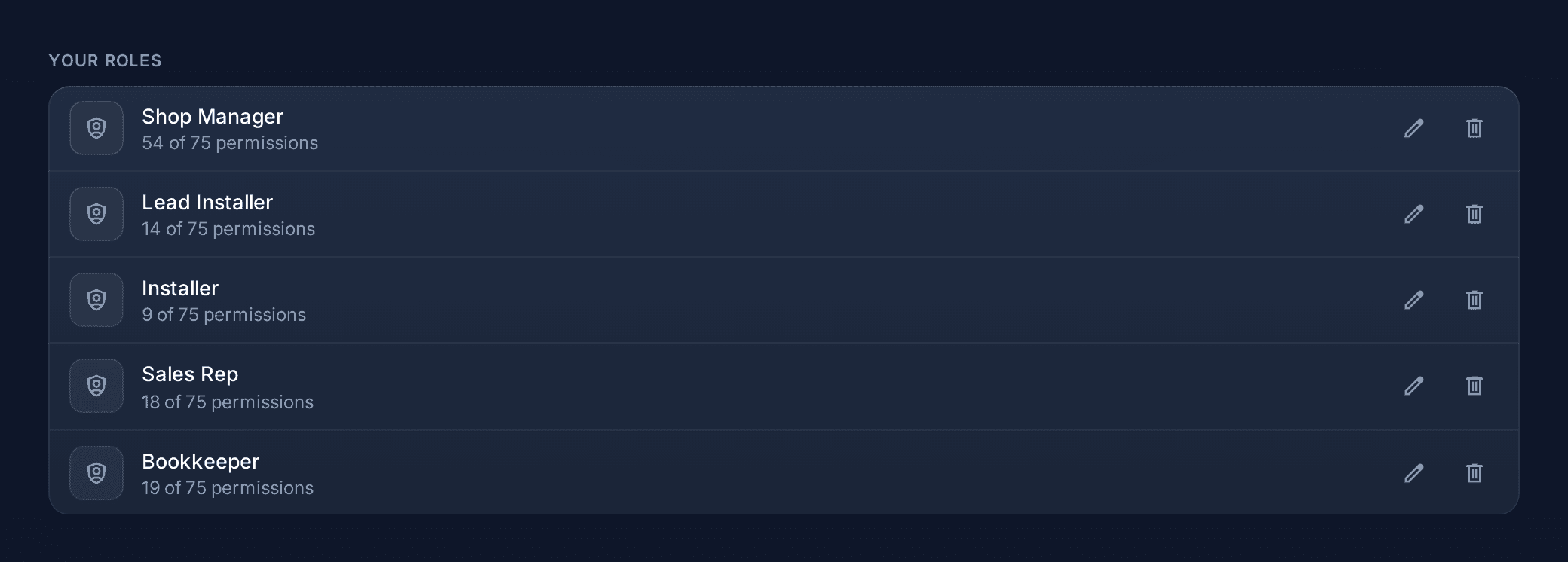
The problemYou shouldn't have to hand the front desk the keys to everything just so they can quote.
Bring the whole crew.
- Roles. Installers see their jobs, sales sees deals, the bookkeeper sees money. Build your own.
- Seats are never counted. Every installer goes in; that's how job timing and film numbers work.
Snappy
The problemYou're the one who knows how anything works, and you're in the back seat with the liner off.
Someone else knows how it works.
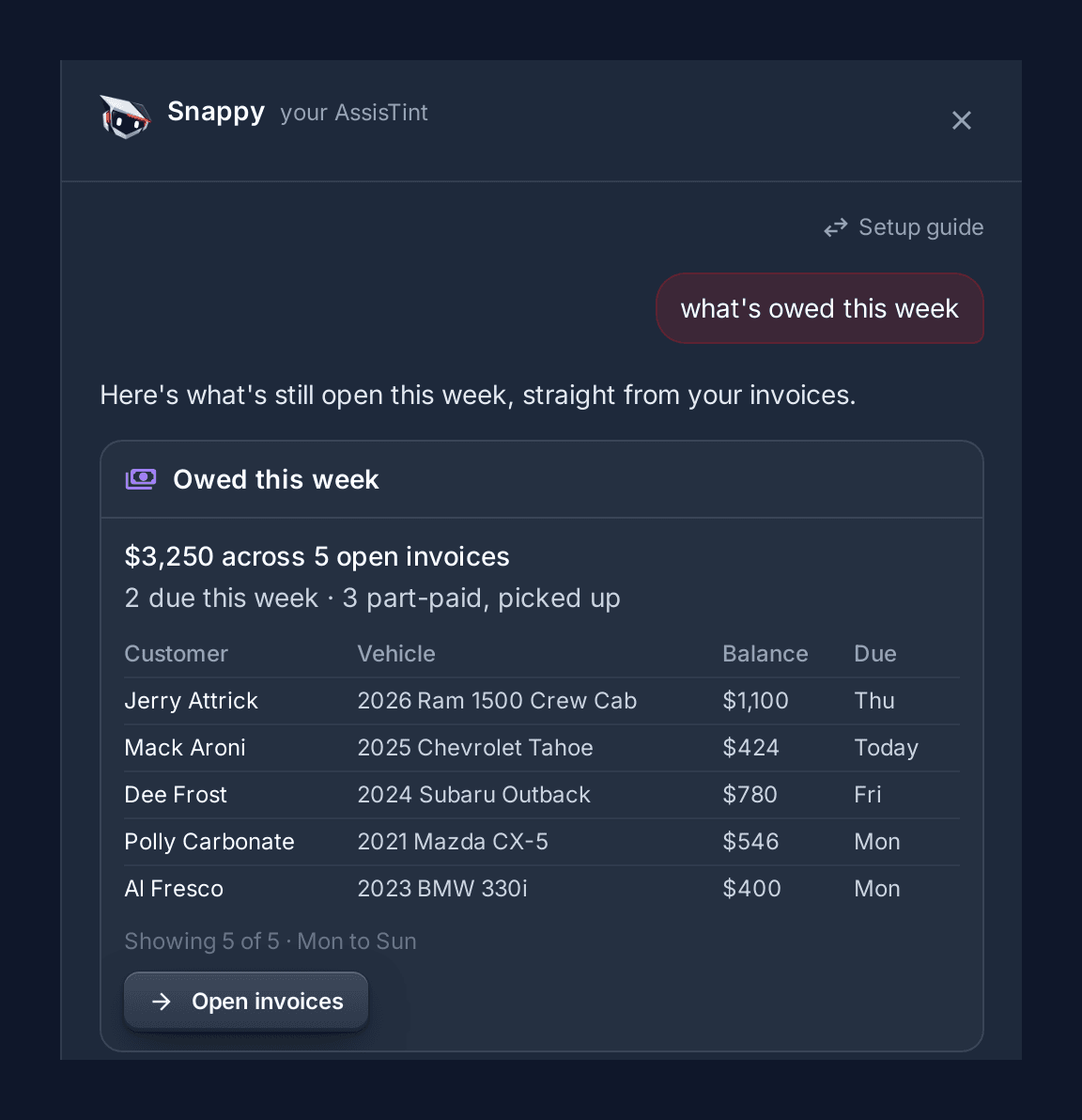
- Snappy, your AssisTint, walks you through setup page by page. After that, “what's owed this week?” comes back as a real report from your own numbers.
What SnapTip never charges for.
Per-seat fees — 0.
Cut of your payments — 0.
Contracts — 0.

Built by a tinter who ran the systems for eight locations
Your shop, out of your head.
I'm Billy. I've run a mobile tint business, run single-location shops, and managed the tint program for a chain. These days I help tinters and shop owners think like business owners, and SnapTip is how I do it. The tinting still shows: back glass breaks out on its own, removal is its own line, the price list is laid out the way you already think about it. But a tinter building for one shop builds for one head. Theirs.
I also designed and managed the systems that kept window tint working across eight locations, and the first thing eight locations teaches you is that you can't be in any of them. So every system I build does one job: it lets people communicate without talking to each other. The price list tells the new hire what the car costs. The schedule tells the installer what their day is. The numbers tell you how the week went. Nobody had to find you to ask.
That's what SnapTip does for a one-bay shop and a multi-location operation. It's built as processes, not features: lead to proposal to schedule to job to invoice to paid is one path, every tool is a step on it, and a feature only shows up when the step needs it. The new hire quotes the right price for the right car. The customer picks a time off the proposal. You see how the week went without typing anything twice. The shop keeps moving while you're in the back seat with the liner off. Founding shops get my phone number, not a ticket queue.
Billy Frickin Murray
Pricing · Founding
One price. Per location.
A location is an address, not a bay. A one-bay shop and a thirteen-bay shop pay the same.
Founding offer
$79/ month per location
$150/mo list price
Locked for life. The first 25 locations. $150/mo after that; you stay at $79.
I'm onboarding the first 25 shops by hand, so there are 25.
- 30 days free. No card to start.
- Never per user. Unlimited proposals, customers, invoices.
- Payments on your own Stripe account at the processor's published rate, nothing added. SnapTip never holds your money.
- No contract. Cancel from your settings. Your data exports with you.
30 days of everything, free. Then keep Pro or move to the free plan. Nothing is deleted.
What founding means.
Not a bigger bundle. Four things that are worth more.
Your rate is locked.
Whatever you pay today, you pay for as long as you stay. When the price goes up, and it will, you don't move.
A direct line to me.
My phone, not a ticket queue. Founding shops tell me what to build next, and I build it.
Your shop in the launch story.
Named as one of the shops that built this.
The industry index, free, forever.
Average tickets, film share, close rates, what tint actually sells for by region. You get it first.
Straight talk on two things.
There will be a free version later. Once I can onboard shops without doing it by hand, a free tier shows up underneath what you have. It'll be less than what you're getting, and your locked rate will sit below whatever the paid price is by then. I'd rather tell you now than have you find out.
I'm building an industry data set, and you're part of it. Aggregate only, never a number built from fewer than five shops. No one ever sees your shop named. Your customers' information never leaves your account. Your data is yours: export it, cancel any time, take it with you.
What I'm asking
- About an hour with me to set up your films, prices and zones.
- Your first real proposal out of SnapTip within two weeks.
- A twenty-minute call once a month for three months to tell me what's wrong with it.
Questions.
What counts as a location?
An address. A thirteen-bay shop at one address is one location and pays once. The price never scales with bays, cars or staff.
Do you charge per user?
No. Add every installer, sales rep and front-desk person you have. Seats are never counted. That's how the job timing and film numbers work.
What happens after the 30-day trial?
You choose: keep Pro at your locked rate, or move to the free plan. Nothing is deleted either way. Your customers, proposals and invoices stay yours, and upgrading later picks up where you left off.
Do you take a cut of my payments?
No. Card payments run on your own Stripe account at the processor's published rate. SnapTip adds nothing on top and never holds your money.
Is there a contract?
No. Month to month, cancel from your billing settings. Your rate is locked for as long as you stay.
Is my data mine? Can I take it with me?
Yes. Export your customers, proposals, invoices and payments any time. Cancel and take it with you. We don't hold your data hostage to keep you.
Do I need a Stripe account?
Only to take card payments through SnapTip. Connecting one takes a few minutes and you own it; Stripe pays you directly. You can log cash and checks without Stripe at all.
Can my installers use it?
That's who it's for. Installers log in, see their jobs for the day, pull film at close-out and mark the car ready. They don't see pricing or money unless you say so.
I have two locations. How does that work?
Each address is a location at its own rate. Bring both in while founding spots are open and both lock at $79. One login, one customer list, each location's schedule and numbers kept apart.
Is my customer data part of the industry data set?
No. What aggregates is facts about jobs and prices: average ticket, film share, close rate, by region. Never a name, a phone number or a plate. Never a number built from fewer than five shops. No one ever sees your shop named.
Does SnapTip cut film?
No. Pattern software cuts the film; SnapTip runs the shop around it: the quote, the schedule, the job, the invoice and the money.
Does it talk to QuickBooks?
QuickBooks Online sync is in final certification. Invoices, payments, customers and purchase orders push over once it clears.
Something else? support@snaptip.app. You get a person.
Send the next quote from here.
Thirty days free, no card. Your first real proposal out the door in minutes, with my help.
30 days free. No card. Cancel from your settings.
$79/mo per location, locked for life for the first 25. Then $150. A location is an address, not a bay.